Generation 305: An Intergenerational Poetry Project
Multiple Dates
Multiple Locations

Generation 305: An Intergenerational Poetry Project
Project by Caridad Moro-Gronlier, in partnership with O, Miami
Generation 305: An Intergenerational Poetry Project is a free, community-based initiative designed to preserve the stories of Miami’s seniors, build connections across generations, and foster meaningful dialogue through poetry.
Facilitated in collaboration with O, Miami, Generation 305 offers free, multigenerational poetry workshops open to K–12 students, their parents, young adults, seniors, and the public.
The project also brings community poets into Miami-Dade Schools to lead workshops that develop civic-minded poetry, promote intergenerational storytelling, and challenge generational stereotypes.
The poems created in the workshops will be turned into permanent public art, and Moro-Gronlier will document the project through photographs, videos, recordings, mini-films, and project-specific, original poetry, which she will use to create a digital archive.
This program is made possible by the generous support of the Academy of American Poets and the Mellon Foundation.
Upcoming Generation 305 Workshops:
January 24, 2026
11am - 1pm
Coral Gables Branch Library
RSVP here!
O, Miami is accepting poetry for Generation 305!
Submit a poem below inspired by an interaction you’ve had with someone from a different generation, younger or older than you. What struck you about that interaction and that person? How did it reveal their story, their culture, and their life (past and/or present) in Miami-Dade?
Generation 305 Sample Poems
(Click the poem title below to reveal the body of the poem)
SHER-O/QUEER-O/BING-O! by Julie Marie Wade
A golden shovel for Maureen Seaton
When I learned we would meet that day at Giorgio’s, my
knees turned right then to strawberry Jell-O. Life
has got my number, I thought, & today Life has
called it up on the signboard—NOW SERVING ONE very
lucky me who, at 33, sat across a little,
wobbling table from you for a chance to
bask in your sprightly light, your generous laugh. O, do
you know what it meant to me to be with
you there, eating frittatas & queering the air all around us? Belief
has carried me farther than fear has slowed me down. O, do
you know how much I wanted to tell you,
though flushed & blustered, aslosh (your word!) with awe? O, believe
I’ve loved you longer than I’ve known you. Know your poems are home to me.
When My Mother First Flies into Miami by Ranijun Ruado
She doesn’t know that the Sand and Sun Hotel on South Beach
will catch fire that evening after a woman falls asleep
with a cigarette in her mouth.
She doesn’t know that five convicts have escaped from prison
and are invading a home in Kendall, holding the residents at gunpoint.
She only knows that the world seems so small
from 30,000 feet in the air. That travelling at 500 miles per hour
doesn’t feel very different than a jaunt on a Manila jeepney.
When my mother first flies into Miami
she doesn’t know that a taxi driver has shot a passenger
who tried to rob him. Or that a man will be found at the airport
carrying 50 pounds of cocaine in his suitcase.
She doesn’t know that, in a year or two, someone will drive off
with her first car, and it will never be found. That, so far in 1982,
there have been 151 homicides in Miami-Dade.
She doesn’t know that the mechanical whirring she hears
is the plane’s landing gear extending or that her eardrums
will start to pressurize and pop as she descends to her new homeland.
She only knows that it has been less than two weeks
since her 25th birthday. That she will not be there to help her family
put up Christmas lights or hold sparklers with them on New Year’s.
She doesn’t know that today is Rosh Hashana. That children
throughout the city are smiling, dipping apple slices
in honey while their rabbis blow shofars.
She doesn’t know that her soon-to-be neighbor in Hialeah is looking
for their lost grey cat. That the Burdines in Westland Mall—just a few
steps from her soon-to-be apartment—is having a clearance sale.
She doesn’t know that a woman has just checked out
the 3,000,000 th book from the county library,
setting off sirens and confetti cannons, scaring her half to death.
When my mother steps off the airplane
she doesn’t know how dangerous and frightening this city is,
nor does she know how kind and beautiful it can be.
But as she notices the schism in the sky, between the clear
lustrous blue and cloudy sallow grey, she soon finds out.
Let’s keep writing in the sky by Nicole Tallman
—For Maureen Seaton (October 20, 1947-August 26, 2023)
A life lived through music takes its place in the night sky.
Your song sings through the stars now, the June moon in the night sky.
Through poems you wrote the music and through books you wrote a life.
I call out to you with elements and your music fills the sky.
You, my Libra sign of air, your red hair a crown of light.
The water breezes through the trees and settles in the sky.
You send me a sunflower and I send you roses in reply.
There were poems we didn’t finish here—let’s keep writing in the sky.
I say, I love the rain, and you say, I love Merwin’s “Rain Light.”
We don’t have to see to know—it’s written in the sky.
All night the hurricane rain is your response to my last line.
Maureen, I kept my promise here—let’s keep writing in the sky.
Dad Was a Ten-Pound Poodle by Mary Block
After Caridad Moro-Gronlier
she says,
And mom was a golden retriever.
I don’t totally get the mechanics
But here she is.
She pats the dog on its curly head,
feeds it cappuccino foam on a spoon.
My husband and I had nothing in common.
He kept the money in the freezer.
Made me beg for his cold singles.
Said he’d rather see me dead
than see me work outside the home.
A platter shatters.
Cafe Stability turns and stares
at the waiter stooping
over the shards of his ruined tray.
We drove down here from Chattanooga.
This was a young town
running on old shame.
I could embarrass my husband
by wearing the wrong hat to Publix.
She lifts her coffee to her lips.
Your grandmother drove me
to Key West at midnight
to keep it out of the Sunday Herald.
She lent me her beauty,
her platinum chatter with the judge.
The flustered waiter drops our check.
And when the divorce went through
she picked me up in her giant Cadillac
and we went flying through the Gables,
waving at neighbors
from a chrome-plated Pegasus.
She leaves a monumental tip.
This town was made for making things up.
You decide where you fit, she says,
picking up her impossible dog.
Poem in Which I Name My Mother’s Courage by Elisa Albo
After Denise Duhamel
Before a revolution bloodies the sand and tramples green
coffee-covered mountainsides of Cuba, my mother is born
into a world war in the north of Spain, 30 miles west of
Guernica. Before she sails in 1950 on the Magallanes
to Havana, nuns at school in Bilbao secure her left hand
behind her eight-year-old back. True fact: Her daughters
are lefties, her son, ambidextrous, her handwriting, still
exquisite. Does she recall the ocean passage with her
mother, Mima to all, a sister, three brothers? It was like
the Titanic: the wealthy on top, the rest of us on the bottom,
and the first time I ate white bread—and marmalade.
In 1958 at a Cuban social beach club, my parents meet,
a year later, marry, Jacobo Albo y Maria Dolores, a middle
name for pain. They honeymoon on Miami Beach, so
desolate in ‘59, they cut the trip short, fly back to Havana,
pick up my father’s black and white Chevrolet, drive to
Varadero. I am born nine months later. My mother is 17,
18 in 1961 when my sister is born, their plans to leave
the island underway when she turns 19 and my father has
to flee to Miami. We will not see him again for a month.
After waiting for days at Jose Marti International Airport,
|my beautiful, blue-eyed Mami crosses the tarmac with
my four-month-old sister in one arm and me in hand—
I am 18 months old. The plane is packed with Cubans
pretending to be tourists, she says, as if Castro didn’t
know, as if he cared. Our lives—what we were used to—
were over. Before we reach Miami, Maria Dolores Franco
de Albo holds my pudgy hand and carries my infant sister
down the hall of a Jamaican clinic, a noisy, crowded
asylum. Before we left Cuba, soldiers at the airport kept
her toothpaste, squeezed it empty for jewelry hidden
inside. In Jamaica my mother brushes her teeth with
a bar of Ivory soap. We receive no milk, little food.
She threatens suicide: a jar of strained peas appears.
A week later, our hotel in downtown Miami is a block
away from an immigration office. Jamaica was bad,
Miami, worse, she recalls. We have milk. She eats
saltines for three days. In sweltering August heat, my
mother waits in line with other Cubans, anxious, hopeful.
No stroller, she carries my sister, keeps a tight grasp on
my hand, her blouse sticking like a stamp on her skin,
but we emerge with official refugee status. That night
my father greets us on the tarmac in Tampa and lifts me
up into his arms. My 19-year-old Mami has made certain.
By 1966, my father passes his medical boards, having
spent hours upon hours of hospital shifts and study in
Tampa, Pottsville, PA, Gainesville, FL, my mother doing
the yeoman’s work with us at home. He learns of two
surgical practices he can join: Plantation or Lakeland
in the center of the State? My mother chooses lakes
over ocean, not proximity to Miami or Cuba. For years
we visit and stay with a score of tias, tios, and cousins
in Miami Beach, vacation summers in hotels there with
family from New York, Mexico, and El Salvador. Her
three children eventually move to South Florida and
a decade after my father passes, like another exile, my
mother laments, she leaves our beloved Spanish style
home they built near a lake and moves to a new one,
with my sister, down the street from me in Plantation.
Instructions for Crossing the Street in Miami as Told to Me by My Teenage Daughter by Mia Leonin
In your childhood home on a canal in Kendall, the window of your add-on bedroom always held the moon perfectly in its frame. At night you read by that light. The stories taught you to cross streets with your wings tucked close and an eye for the errant kitten in need of rescuing or a rooster to shoo across the street.
The stories taught you to pack an extra pastelito in your bookbag to give to the man who lives on the bus bench because the one time, you gave him beef jerky, he informed you, I cain’t eat that, mama. I ain’t got teeth.
In Miami canals, even the ones that harbor gators, boas, and toxic run off, are safer than streets.
When men shout “you must be Cuban” they mean hips.
When men call you chinita, they don’t see Lima, Peru, or your abuela who grew up speaking Quechua.
When men your father’s age stare at you from red lights, mouths agape, you point your phone at them like a can of mace and start filming.
If a leering man at the light is making a left-hand turn, you might raise a middle finger as you cross the intersection knowing he can’t turn right to follow you. Or maybe you don’t think it through at all; you just feel justified to return insult with indignation.
Once a thirty-three-year-old coworker at DSW followed you home. He made small talk on the train, told you he wished he had a girlfriend like you. You moved seats. He got off at your stop in the Grove even though he said he lives in Opa-locka.
You descended the stairs from the platform, crossed US1 with other pedestrians, aware that he was somewhere behind you. You walked down 27th avenue.
You did not cross the street even though home was so close but instead strolled purposefully into noisy Flannigan’s and waited for your big sister to come.
The next day you reported him to HR. When they didn’t do anything, even though other employees had said he makes them feel uncomfortable, you wrote a letter to company headquarters.
Yes, to cross the street, you must know how to write a letter whether they read it or not.
Miami Beach Honeymooners by Catherine Esposito Prescott
Deco hotels lined
Collins Avenue
like pastel pearls
on a string, before high-
rises blocked the ocean
from a pedestrian’s view,
back when air travel
was rare and people
wore their best clothes
to fly, that’s when they
arrived, young and
new to their first and
only vacation.
Sun-honeyed,
I think of them
in the pause
before nine children,
before fires fought,
before green mountains–
in the play-
ground, the nursery,
where seven
decades later, their
great-grandchildren
would learn to walk,
to swim, and where
one would cross over
at 18, four years
after his great-
grandmother who left
at 100; they who led
us here, who knew
the place we
would find,
where light
pours
through your
body as if you
were the very
essence of limestone.
What did they know
of light, two kids
from the city?
What did they seek
but couldn’t name
in their lifetime?
What they had–
every child
through adulthood,
we lost. And how
they lost, we did
too, one child
to brain cancer.
The parallels
couldn’t be
scripted by human
hands if we tried,
so I record
what we’ve
been given, light
in abundance,
on the beach, far
from where we
were originated,
far from where we
expected to
and never meant
to stay.
When I Was Young by Marci Calabretta Cancio-Bello
We had no air conditioning
in any of the classrooms
but back then folks knew
what they were doing.
Each room poured out
into a courtyard
the wind swept
and it wasn’t nearly as hot
then as it is now. Now
apartments rise like heat
or water sweeping
ever closer and into my yard
blocks at a time blotting out
my view. What can I do
but keep moving? I thought
back then I had no room
but look at these conditions
now that I’m old.
Ernst Takes His Guitar Everywhere by Jen Karetnick
—in the car on the way to his wife’s doctor
appointments, on walks to the Little River
through Sherwood Forest—in case I get bored,
he says, as if he were seven instead of 70,
retired from 40 years of civil engineering
for the city. Painted with Kreyòl in rust-red
and keloided with tape, the instrument
travels caseless, neck gripped in his left
fret-working hand, belly of it on his knees
like a grandchild. He plays while he paces
in front of his house and the ylang-ylang tree
he uses for home remedies, swearing they keep
him free from disease. Do you sing? he asks
when I pass by with my dogs on their evening walk.
Yes, I say, but I’m out of voice, a phrase
he doesn’t believe in, that makes him laugh
in his screen-door wheeze as if his vocal cords
have been rubbed out by a lifetime of shouting
down bureaucracy, though he still carries a tune
as easily as I do my dachshunds, who bark
over the beat, interrupting him to encourage me:
You know this one! The setting sun’s liquescent
gold plates his platinum curls, the ylang-ylang
leaves shimmy off their silvery perfume to attract
the night’s pearl-winged pollinators, and surrounded
|by the precious metals of his world, I join in.
BERNIE by Denise Duhamal
After I broke my wrist I had to ask
Casey at the front desk to help me
bring a box of books to my apartment.
Copies of a book I’d written
when I could still type with two hands.
Casey had just graduated from college
where she’d taken a creative writing class
so I gave her my book and a ten.
I couldn’t open a jar or the bottle of pain pills
my friend Julie picked up for me at Walgreens.
I couldn’t wash my own hair. I couldn’t drive.
And when John and Cindy took me
to see the orthopedic surgeon, they had to
buckle me in.
I’d lived in the same building
for 25 years. I saw many neighbors go
from swinging tennis rackets to shuffling
with walkers grounded with yellow tennis balls.
I looked at my swollen fingers, almost gray
to match my cast. And I remembered Bernie,
who lived next door. Shortly after I moved in,
he knocked—I’m so embarrassed, so embarrassed,
but will you please help me put in these eye drops?
Bernie tilted his head. I lifted his top lid
and squeezed the bottle until the medicine itself
was a single tear. Bernie had just lost his wife.
I was still unpacking boxes when the EMTs came
and rolled her on a stretcher down the hall.
I heard the ping of the elevator and Bernie
mumbling a prayer.
Shortly after, he gave me
an Afghan she’d crocheted, orange and yellow
zig zags. I knew him mostly as a widower.
He was both gregarious and lonely, his son
in jail. His daughter in New York. Now
a young couple live in his unit, their toddler
obsessed with her convertible “grow and go”
Minnie Mouse car seat and stroller. The last time
I saw Bernie, he asked if I could give him a ride
to his new place, the nursing home. I helped him
with his seatbelt. I twisted my wrists
on the wheel, taking each turn with ease.
Dedication (To the White Women of Miami-Dade) by Anjanette Delgado
After Ámbar Past
This is for the white women of Miami-Dade
who didn’t go north
to escape the foreigners—
who still knock on doors
to welcome new neighbors,
and make as if they understand—
even when the accents are thick
and newcomers think nothing
of looking askance at cookies
bought with dollars meant for yarn.
This is for the white women
who remember the ’60s,
and the miniskirts they wore
to protest everything—who look
at my necklace with the 1973 on it
and smile, ask if I’m in a hurry
and, if I am, wave me ahead
in line, needing no explanation
for what the chain around my neck mourns.
This is for the white women who,
when they see a Latina girl moving
everything the good Lord gave her
while swaddled in a third less textile
than modesty supposedly requires,
smile and say: Let her be! What else
were we fighting for, if not her?
This is for the white women who taught
in Miami-Dade—kids who were
white, Cuban, Haitian, and Black—
who hid those children in libraries
and janitor closets during lunch
so they wouldn’t get beaten up
by kids hopped up on the venom
of their parents’ politics.
Who sat with children
long after after-school pickup,
and when the Black or brown
immigrant mother arrived, harried,
breathless, near tears from traffic,
said: Do not worry. Your child is a treasure.
This is for the white women who don’t take
it personally when people speak of white
privilege, as if entitlement came
in only one shade, who scoff at women
who don’t support the feminine
after they nearly faced divorces for raising
their boys to wear pink shirts with pride,
to bring home every kind of friend,
so long as they were good, and tender
of heart, and could be taught to recognize
love even in the blinding sun.
Yes, this poem is for the white women
who carry the knowledge of what whiteness
has done and still does—and surprise us
by standing for justice, against racism,
fascism and genocide, not because
they’re activists, but because
they have eyes and ears, and a soul.
This is for the white women of Miami-Dade
who love children not their own,
and hand out orange slices
because fruit is important,
because it helps you grow strong,
and because it is also sticky
and sweet on the tongue. Who tend
backyard mango trees
in the swelter of humid heat
and know the Spanish names of flowers
though they speak no other words
in the language of Cervantes.
This is for the white women who outlived
husbands and lovers and children, and fled
cold communities, and still built things
afterward, for themselves
and others. Who lock the door
behind them at dawn and walk
the boardwalk alone, unafraid,
white women who run
their hands over coral walls and remember
when Wynwood was warehouses
and not galleries—who paint and throw pots
because they refuse to stop believing
in beauty for its own sake.
Today, I dedicate this poem
to the white women of Miami-Dade
who invite me to drink the Cuban coffee
they say they learned how to make
years ago—and love—to you I say this:
I will drink your Cuban coffee, but not say
it’s so good I don’t know the difference.
Instead, I’ll say I was that brown girl
you hid in the library during recess,
who learned to speak up in boardrooms,
and raised her girls to be troublesome
and opinionated—and who’s known
for a while that so many of us
would not have survived it without you.
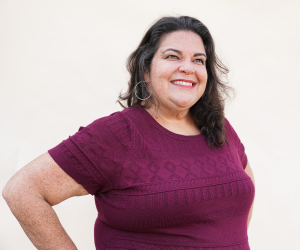
Caridad Moro-Gronlier, born in Los Angeles to Cuban immigrant parents and raised in Miami, is an award-winning poet and longtime educator for Miami Dade Public Schools. She is the author of four poetry collections, including Tortillera (Texas Review Press, 2021), winner of the TRP Southern Poetry Breakthrough Prize, and the forthcoming Through the Lens and As to Your Comment (TRP, 2026 & 2027). She is also the editor of Grabbed: Poets and Writers Respond to Sexual Assault, Empowerment and Healing (Beacon Press, 2020). Moro-Gronlier serves as senior editor of SWWIM Every Day and poetry curator-at-large for The Betsy Hotel’s Writers Room. Her work has been featured across South Florida’s literary and cultural institutions. She is the recipient of numerous awards, including a 2025 Academy of American Poets Laureate Fellowship. In 2025, she was also selected as a judge for the National Book Award. She lives in Miami with her family.